

 Apple Podcasts
 Spotify
 Amazon Music
 iHeartRadio
 YouTube
 Trump, Voting Rights & Black America / Fear, Facts and Fallout
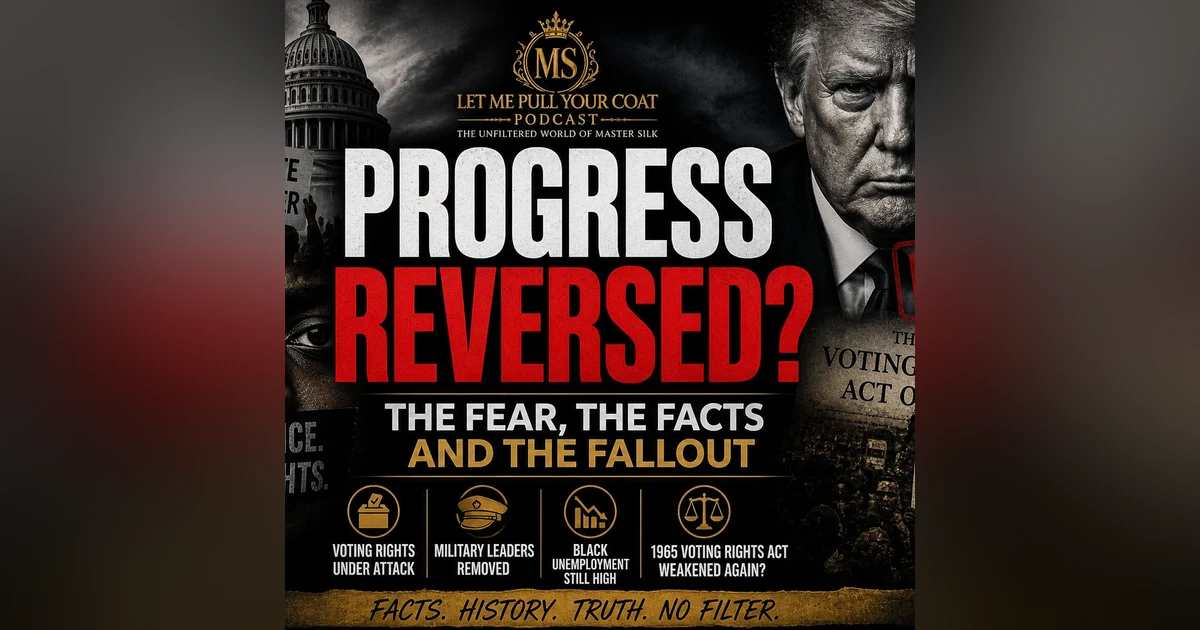

PULL YOUR COAT We take on a listener’s heavy question about whether the Trump administration is waging a war on Black Americans, and we refuse to treat it like a shouting match. We look at policy, court rulings, and real fears, then land on what protects progress when politics shifts. • why voting rights enforcement and election policy changes fuel fear and distrust • how redistricting rulings and Section 2 debates shape Black political power • what the Pentagon leadership removals signal to ...
We take on a listener’s heavy question about whether the Trump administration is waging a war on Black Americans, and we refuse to treat it like a shouting match. We look at policy, court rulings, and real fears, then land on what protects progress when politics shifts.
• why voting rights enforcement and election policy changes fuel fear and distrust
• how redistricting rulings and Section 2 debates shape Black political power
• what the Pentagon leadership removals signal to supporters and critics
• how Black unemployment and “good economy” claims don’t land the same everywhere
• why modern politics feels like narrative more than shared fact
• the deeper issue of progress that can be reversed
• lessons from Rome about slow decline through division and institutional distrust
• practical moves that matter most: research, local strength, ownership, civic participation
This is not a screaming match. It is a serious conversation about policy, fear, history, and reality.
Make sure you follow, subscribe, and leave a review.
LOW LIT BLUES LICENSE CODE: XHOI81LBH8H9JPLI
DON'T FORGET TO FOLLOW MASTER SILK ON ALL SOCIAL MEDIA PLATFORMS.
https://www.youtube.com/@ogmastersilk
https://www.instagram.com/chi_towns_og_mastersilk/
https://www.tiktok.com/@silktaylor
https://bsky.app/profile/mastersilk7630.bsky.social
https://www.fanbase.app/@mastersilk
https://www.facebook.com/silk.james.79
https://www.snapchat.com/add/mastersilk_17
00:00 - A Hard Question From Abroad
01:26 - Voting Rights And Federal Power
03:02 - Pentagon Shakeups And DEI Backlash
04:12 - Economics And Competing Narratives
04:54 - Progress Can Be Reversed
06:21 - Rome’s Slow Decline As Warning
08:17 - What To Do Beyond Outrage
09:34 - Shout Outs And The Core Lesson
11:11 - Follow Subscribe And Closing
A Hard Question From Abroad
Master SilkWelcome back to Let Me Pull Your Coat. This week we're stepping into dangerous territory. Not street dangerous, political dangerous. Because one of the most emotional questions we received this week came from Assad in Algiers, Algeria. And he asked something heavy. He asked, What do you think about the Trump administration's all-out war on black people in America? Now, before we even get into this, this episode is not about screaming. It is not about party loyalty. And it is not about blind emotion. This episode is about perception, policy, fear, facts, and consequences. Because whether people agree or disagree with that question, millions of Americans are asking versions of it right now. Before we get started, go to letmepullyourcoat.com, leave your voice message, check the Your Post page, read the reviews page, watch the video page, sign up for our newsletter, and go subscribe to True Tales from the Let Me Pull Your Coat Podcast on YouTube. Follow us on Instagram, Facebook, Fanbase, TikTok, Blue Sky, and YouTube. And shout out to everybody supporting us through Buy Me a Coffee and Cash App. You're helping keep this platform independent and honest. Now
Voting Rights And Federal Power
Master Silklet's deal with the question. One reason many black Americans feel targeted is because of recent actions connected to voting rights, military leadership, and diversity initiatives. In 2025, the Trump administration's Justice Department shifted priorities inside the voting rights section of the Civil Rights Division. Reports described experienced voting rights attorneys leaving or being reassigned, while the department focused more heavily on voter fraud investigations and election integrity policies. Critics argued this weakened federal protections that had historically been used to defend minority voting. At the same time, the administration supported election policies that opponents said would make voting harder for some communities. A 2025 executive order on federal elections triggered legal criticism from voting rights organizations that argued the president was attempting to expand executive control over election administration. And recently, Supreme Court rulings connected to Louisiana redistricting narrowed how Section 2 of the Voting Rights Act could be applied in congressional mapping disputes. Critics, including dissenting justices and civil rights advocates, argued the decisions weakened protections that black voters had relied on since the civil rights era. Now, whether someone sees that as election integrity or voter suppression depends heavily on politics and perspective. But the fear itself is real. Then there's the military issue.
Pentagon Shakeups And DEI Backlash
Master SilkIn early 2025, General C.Q. Brown Jr., the second black chairman of the Joint Chiefs of Staff, was removed from his position as part of broader Pentagon leadership changes. Critics argued the administration was targeting military leaders associated with diversity and inclusion policies. Additional senior officers, including several women and black leaders, were reportedly dismissed or pushed out during restructuring inside the Pentagon. Supporters of the administration framed the moves as removing politically aligned leadership and eliminating DEI influence. Opponents described it as an ideological purge. And this is where things get complicated. Because in America, politics rarely arrives as pure fact anymore. It arrives as narrative. One side says, we are restoring merit and law. The other side says, you are dismantling decades of progress, and regular people are stuck in the middle trying to figure out what is actually happening.
Economics And Competing Narratives
Master SilkNow let's talk about unemployment and economics. Black unemployment rates have historically remained higher than white unemployment rates regardless of administration. But critics of Trump argue that economic gains, often highlighted nationally, do not always translate equally into black communities, especially when federal diversity programs and civil rights protections are being reduced. Supporters of Trump counter by pointing to broader economic growth, lower inflation pressures, and arguments that identity-based hiring policies unfairly disadvantage others. Again, same country. Different interpretation.
Progress Can Be Reversed
Master SilkBut let me pull your coat on something bigger than Trump. Black Americans have always had a complicated relationship with progress in this country. Every generation believes certain victories are permanent until politics changes. That fear is not new. The Voting Rights Act of 1965 was considered one of the most important civil rights achievements in American history. Over time, portions of it have been weakened through court rulings, including major Supreme Court decisions dating back years before Trump returned to office. Critics now argue that recent rulings and Justice Department changes are accelerating that erosion. And that creates a bigger emotional question underneath all of this. Not just who is president, but how secure is progress in America if it can always be reversed. Now here's where I'm going to get real. A lot of people wait for politicians to save them. History shows that's dangerous because administrations change, policies change, courts change, and every time power shifts people panic like they never expected the system to move. The real power has always been organization, education, economics, ownership, and participation. Because
Rome’s Slow Decline As Warning
Master Silkno administration lasts forever, but the condition of your community can. And let me say this carefully: not every Trump supporter is racist, and not every criticism from black Americans is imaginary. Both things can exist at the same time. That's the problem with modern politics. Everybody wants simple villains and simple heroes. Real life does not work like that. Rome did not dominate the world for a few years. Rome controlled massive portions of the gnome world for centuries. Its rise began around 27 BC under Augustus, and the Western Roman Empire lasted until 476 AD. Even after that, the Eastern Roman Empire, known as the Byzantine Empire, survived for nearly another thousand years. That means Rome's influence lasted well over a thousand years in different forms. But here is the important part. Rome did not collapse in one dramatic moment. It weakened slowly. Political division, economic instability, corruption, loss of trust in institutions, internal fighting, leaders more focused on power than unity, citizens becoming distracted while systems underneath them weakened. And by the time many people realized how serious things had become, the foundation was already cracked. Now let me be clear: America is not row. But history teaches patterns. Every powerful nation eventually faces moments where people begin questioning whether the system is protecting everybody fairly, whether leadership serves the people or itself, and whether divisions inside the country are becoming stronger than the things holding it together.
What To Do Beyond Outrage
Master SilkSo what can Americans actually do instead of just arguing online and panicking? First, people need to become informed beyond headlines and social media clips. Too many people build their entire political worldview from outrage instead of research. Second, communities have to rebuild local strength, strong families, local businesses, education, ownership, financial literacy, and civic participation matter more long-term than emotional political slogans. Third, people need to stop treating every disagreement like warfare. Once citizens start seeing each other only as enemies, the country weakens from the inside no matter who is in office. And finally, people need to participate instead of just complain. Vote. Learn the law, understand policy, attend local meetings, support organizations that actually help your community instead of just talking online. Because history shows something very clearly. Powerful nations rarely collapse because of one enemy from the outside. They weaken when enough people inside stop believing they have a responsibility to protect what they
Shout Outs And The Core Lesson
Master Silkbuilt. Here is this week's shout outs. Shout out to Assad in Algiers, Algeria for sending this week's question. Shout out to Rochelle in Baltimore, Maryland. Shout out to Malik in Detroit, Michigan. Shout out to Tamika in Atlanta, Georgia. Shout out to Devon in Oakland, California. Special shout out to everybody who signed up for the newsletter this week. And a major shout out to everyone supporting us through Buy Me a Coffee and Cash App. Here is your COP poll of the week. The most dangerous thing any community can do is become emotionally dependent on politics while remaining economically weak. Because politicians come and go, parties rise and fall, laws get challenged, courts change direction, and every generation learns the same painful lesson progress that is not protected can be reversed. That does not mean panic, that means preparation. Because fear alone changes nothing. Organization changes things. Education changes things. Ownership changes things. Participation changes things. And if history has taught black Americans anything it is, that no progress ever came from comfort. It came from pressure. It came from sacrifice. And it came from people understanding that survival requires more than emotion. It requires strategy. This is Let Me Pull Your
Follow Subscribe And Closing
Master SilkCoat. Make sure you follow, subscribe, and leave a review. Go to LetMepullYourcoat.com and explore everything. Voicemail, your post page, reviews page, video page. And don't forget to watch True Tales from the Let Me Pull Your Coat podcast on YouTube. Because those stories are what happens when power, choices, and consequences collide. This is Master Silk. Thank you for your love and support. Until next time, I wish you much love and much respect.

