Unmasking the Six Lies Distorting Your Daily Life
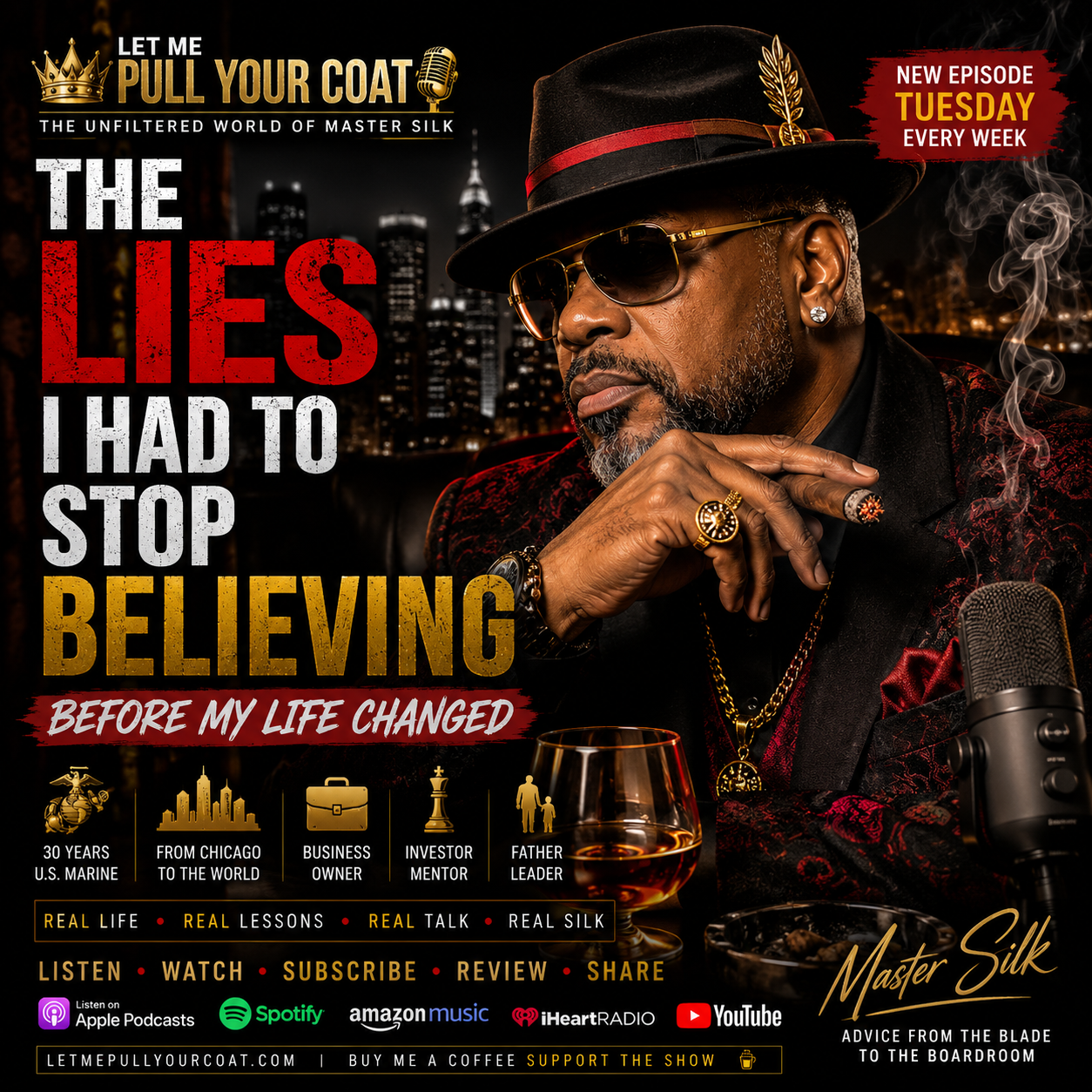
Welcome back to the digital extension of the podcast. If you have been listening for a while, you know we do not pull any punches around here. We talk about the raw realities of building a life, surviving mistakes, and stepping into true personal accountability. Recently, we dropped an episode that hit a massive nerve with our listeners. We answered the question people ask us the most: how Master Silk becomes who he is, not through a series of flawless, pristine choices, but by surviving the costly ones. In that conversation, we broke down six pervasive lies that distort how we view loyalty, money, relationships, work ethic, helping others, and time. If you missed it, you can catch the whole conversation over at the Six Lies That Quietly Wreck Your Life episode page. Today, we are going to unpack those concepts even further, expanding on the core deceptive mindsets and showing you how to pivot toward genuine ownership and personal discipline.
Introduction: Surviving the Costly Choices
We live in a culture obsessed with perfection. Social media feeds are flooded with overnight success stories, curated aesthetics, and highlight reels that pretend nobody ever stumbled. But real life is messy. Real growth is forged in the fire of costly mistakes. When we look back at our biggest missteps, they usually trace back to subtle untruths we accepted as gospel. These lies creep into our daily routines, whispering in our ears and convincing us that our flawed paradigms are normal. To break free, we have to unmask them one by one.
Lie Number One: Misunderstanding Loyalty When There Is Something to Lose
The first lie we tell ourselves is that loyalty is cheap and easily given. People throw the word loyalty around like confetti when times are good. Everyone is your friend, your ride-or-die, or your dedicated team member when the sun is shining and the profits are rolling in. But true loyalty is not proven in the comfortable moments; it is proven when there is something genuinely on the line to lose.
When the pressure mounts, resources dry up, or a difficult stand has to be taken, that is when the masks slip. If someone only stands by you when it costs them nothing, that is not loyalty—that is convenience. We must learn to value patterns over promises. Words are cheap, but consistent behavioral patterns over a long horizon reveal who is truly in your corner when the stakes are high.
Lie Number Two: How Money Reveals Character Rather Than Changing It
How many times have you heard someone say that money changes people? It is a cultural mantra that we repeat without thinking. We look at someone who acquired wealth and turned arrogant, or someone who came into cash and became reckless, and we blame the currency.
Here is the truth: money does not change people; money simply amplifies who they already are. If a person is generous and grounded with ten dollars, they will be philanthropic and scaled up with ten million. If a person is insecure, deceitful, or greedy when they are broke, giving them a massive bank account just hands them a microphone to broadcast those exact flaws on a larger scale. Stop envying lifestyles and start studying character.
Lie Number Three: Redefining Relationships Through Respect and Accountability
We often enter relationships expecting Hollywood scripts, ignoring the foundational pillars required to keep two human beings anchored together. Love is not just a feeling; it is an active discipline. A major lie we buy into is that deep connections can survive on passion alone, bypassing the heavy lifting of mutual respect and boundaries.
Real, lasting relationships require radical honesty, transparent communication, and strict accountability. If you cannot look your partner, friend, or business associate in the eye and hold them accountable—and equally important, invite them to hold you accountable—you do not have a real relationship. You have an arrangement of convenience that will shatter the moment a real storm hits.
Lie Number Four: Trading Busyness for Intentional Hard Work
In our modern hustle culture, we confuse motion with progress. We wear our exhaustion like a badge of honor, bragging about how many hours we worked or how many emails we answered. This is the lie of busyness.
Hard work guided by intention yields exponential results, whereas endless, scattered busyness just burns you out. You can spend twelve hours a day spinning your wheels, reacting to every trivial emergency, and accomplish absolutely nothing of substance. True discipline means stepping back, defining your targets, and executing strategic, high-value tasks with laser focus.
Lie Number Five: The Trap of Enabling Versus Truly Helping Others
Compassion is a noble trait, but misdirected compassion can destroy both the giver and the receiver. A dangerous lie is that every time someone asks for a rescue, a true friend or leader must step in and bail them out.
We have to learn to separate genuine help from enabling. When you constantly rescue people from the natural, painful consequences of their own poor choices, you rob them of the lessons they desperately need to grow. True help empowers people to stand on their own two feet. Enabling keeps them perpetually dependent on your rescue missions.
Lie Number Six: Treating Time as a Non-Refundable Investment
Most people treat time like an infinite resource that just keeps refilling every morning. We scroll aimlessly, entertain toxic people out of boredom, and invest our energy into projects that have no future.
Time is the ultimate non-refundable investment. Every single second you spend is a stock purchase in a specific outcome. When you realize that you cannot get yesterday back, your perspective shifts dramatically. You start guarding your schedule, auditing your associations, and investing your hours with the same rigorous care that a venture capitalist applies to a multi-million-dollar portfolio.
Pivoting Toward Genuine Ownership and Personal Discipline
Unmasking these six lies is only half the battle. Once you strip away the illusions, you are left with a choice: do you keep making excuses, or do you step into total ownership?
Ownership is the ultimate path to options. When you stop blaming your childhood, your boss, the economy, or bad luck, and instead take full responsibility for your current standing, something powerful happens. You reclaim your agency. Paired with daily personal discipline, ownership transforms your chaos into structure. Furthermore, when you are starting a new business venture, pursuing a creative path, or fixing a broken mindset, remember that progress beats perfection every single time. Do not wait for the stars to align. Take messy, decisive action and course-correct along the way.
Conclusion: Progress Over Perfection on the Path Forward
Navigating life without falling into these deceptive traps requires constant vigilance, self-reflection, and a willingness to look in the mirror and tell yourself the unvarnished truth. By understanding that loyalty is tested by loss, money reveals character, relationships demand accountability, work must be intentional, help should never morph into enabling, and time is a finite investment, you set yourself up for a life of authentic power and stability.
If this discussion resonated with you and you are ready to dive deeper into these principles, make sure you listen to the full discussion by checking out the Six Lies That Quietly Wreck Your Life episode. Share this post with a friend who needs to hear it, leave a review, and keep showing up for yourself every single day.

Owner/CEO/Host
🎤 Master Silk
No fairytales. No filters. Just lived experience and hard-earned clarity.
Born and raised on the South Side of Chicago, Master Silk was shaped by worlds most people only hear about from a distance.
He has lived on both sides of the line — the streets and the boardroom — and understands the real consequences tied to money, relationships, power, loyalty, and survival.
His background spans military service, business ownership, legal training, fatherhood, and high-risk environments where decisions carried real consequences. Nothing shared on this platform comes from theory. Every lesson was paid for through experience.
Background & Credentials
Master Silk’s path includes work in nightlife and adult entertainment businesses, corporate ventures, real estate, and legal environments where contracts, accountability, and consequences matter.
His education and training include:
• Juris Doctorate
• Doctoral-level study in psychology
• Certifications in financial planning and financial counseling
This combination allows him to speak clearly about behavior, boundaries, money, relationships, and decision-making from both practical and professional experience.
Why People Listen
People don’t come to Master Silk for fantasy, hype, or empty motivation.
They listen because he speaks honestly about:
• What bad decisions actually cost
• How people confuse attention with respect
• Why clarity matters more than comfort
• How power is rebuilt quietly — not lou… Read More

Rebuilding From Scratch: The Mindset You Need When Everything Disappears